
Market-Led Proposals? Expert Insights Inside
Market-led proposals represent a fundamental shift in how B2B companies approach sales and business development. Rather than pushing predetermined solutions onto prospects, market-led proposals are fundamentally driven by real market data, customer behavior patterns, and competitive intelligence. This approach has become increasingly critical as buyers demand more personalized, relevant solutions that directly address their specific pain points and market conditions.
The modern buyer expects vendors to understand their industry, competitive landscape, and current market pressures before even entering a sales conversation. Market-led proposals deliver exactly that—they demonstrate deep market awareness and position your solution as strategically aligned with where the prospect’s business is headed. This comprehensive guide explores what market-led proposals are, why they matter, and how to implement them effectively in your organization.

What Are Market-Led Proposals?
Market-led proposals are comprehensive business documents that lead with market insights, competitive analysis, and industry trends rather than immediately diving into product features. These proposals position your solution as a strategic response to specific market conditions and buyer challenges. They demonstrate that your organization has done extensive research and understands not just the prospect’s company, but the broader ecosystem in which they operate.
Unlike traditional proposals that often follow a generic template, market-led proposals are heavily customized and data-informed. They answer critical questions before the prospect even asks them: What challenges is this industry facing right now? How are our competitors positioning themselves? What opportunities exist in this market? How does our solution capitalize on these market dynamics?
The foundation of a market-led proposal includes competitive intelligence, industry benchmarking data, emerging market trends, customer success stories from similar market segments, and clear ROI projections based on market-specific metrics. This approach requires deeper research and strategic thinking, but the payoff in win rates and deal velocity is substantial.
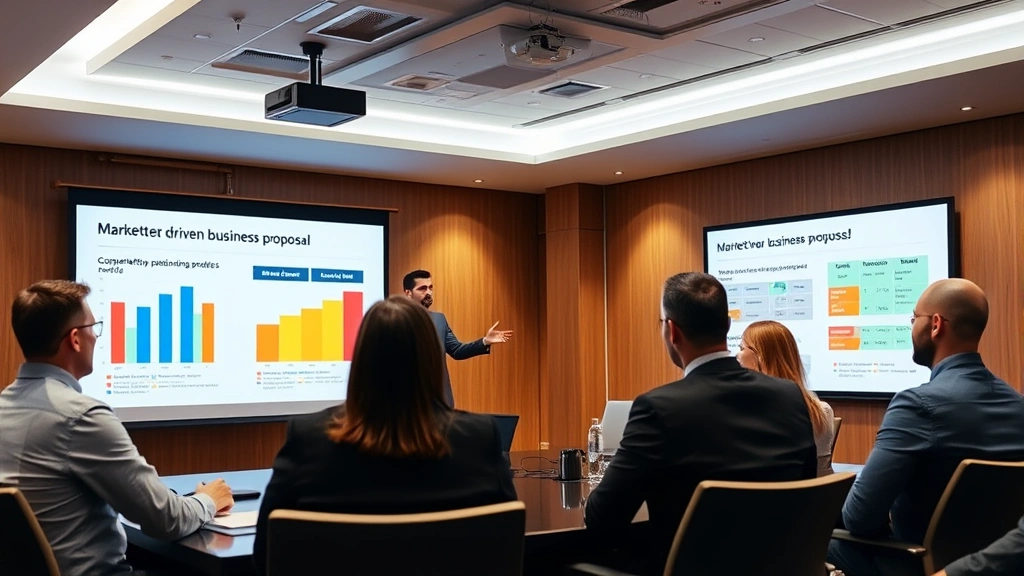
The Business Case for Market-Led Proposals
Organizations that embrace market-led proposals consistently outperform those using traditional approaches. According to Forrester Research, companies that personalize proposals based on market and competitive data see a 40% higher close rate compared to generic proposals. This isn’t just about better messaging—it’s about fundamentally aligning your value proposition with where the market is heading.
The business case rests on several key factors. First, market-led proposals reduce sales cycle length. When prospects see that you understand their market pressures, they’re more likely to move quickly because you’ve eliminated the need for extensive discovery calls. Second, they increase deal size and contract value. By positioning your solution as a strategic market response rather than a tactical fix, you can justify higher price points and expanded scope. Third, they improve win rates against competitors. In competitive situations, the proposal that demonstrates superior market understanding typically wins.
Additionally, market-led proposals create stronger customer relationships. When you deliver a proposal that shows deep market knowledge, you position your organization as a strategic partner rather than just another vendor. This foundation leads to longer customer relationships, higher retention rates, and increased upsell opportunities. Customers who buy based on market-led proposals tend to view you as a trusted advisor who understands their business context, not just someone selling a product.
The financial impact is measurable. McKinsey & Company research shows that sales teams using data-driven, market-informed proposals achieve 23% higher deal values and 31% faster sales cycles. For a typical mid-market SaaS company, this translates to millions in additional annual revenue.
Key Components of Effective Market-Led Proposals
Building effective market-led proposals requires understanding and integrating several critical components. Each element serves a specific purpose in demonstrating market awareness and strategic alignment.
Market Context and Trend Analysis
Open your proposal with a compelling market narrative. What’s happening in the prospect’s industry right now? Are there regulatory changes, technology disruptions, or competitive pressures reshaping the landscape? Cite specific data points from credible sources. For example: “The financial services industry is experiencing a 45% increase in digital transformation investments this year, with 67% of institutions prioritizing cloud migration as their top technology initiative.”
This section should be 2-3 paragraphs maximum, but packed with insights that make the prospect nod and think, “Yes, this is exactly what we’re dealing with.” The goal is to establish that you’ve done your homework and understand their operating environment.
Competitive Intelligence and Market Positioning
Address the competitive landscape directly. How are competitors responding to market changes? What gaps exist in current solutions? Where does your offering fit within the competitive matrix? This doesn’t mean attacking competitors directly, but rather positioning your solution as the most strategically aligned choice given current market dynamics.
Use competitive positioning matrices, market share data, and feature comparison tables that highlight not just what you do differently, but why those differences matter in the current market context. Reference industry analyst reports from firms like Gartner and Forrester to add credibility.
Customer Success and Market Proof Points
Include case studies and metrics from companies operating in similar market segments or facing comparable challenges. Rather than generic testimonials, provide specific, quantifiable outcomes. “Customer in financial services increased transaction processing speed by 60% and reduced operational costs by $2.3M annually.” These proof points demonstrate that your solution delivers real results in market conditions similar to the prospect’s.
Strategic Alignment and Market Opportunity
This section connects your solution to the prospect’s market opportunities. Based on industry trends and their competitive position, what can they achieve? How does your solution enable them to capitalize on market opportunities others might miss? Frame your offering as the strategic enabler of their market ambitions, not just a tool to solve today’s problems.
Market-Specific ROI and Financial Modeling
Use market benchmarks and industry-specific metrics to build credible financial models. If you’re selling to healthcare providers, reference healthcare-specific cost structures, reimbursement models, and efficiency benchmarks. This specificity makes your ROI projections far more believable than generic financial models. Include sensitivity analysis showing different scenarios based on market conditions.
Data-Driven Strategy Development
Creating market-led proposals requires building a robust data infrastructure and research capability within your sales organization. This goes beyond what most traditional sales teams currently do.
Building Your Market Intelligence Foundation
Start by establishing systematic processes for gathering and organizing market data. This includes industry reports from analyst firms, earnings call transcripts from publicly traded prospects, news and press releases, regulatory filings, and proprietary research. Many organizations use tools like Semrush for competitive intelligence and market trend monitoring.
Create a centralized repository where sales teams can access market research, competitive intelligence, and industry benchmarks. This might be a shared knowledge management system, a sales enablement platform, or a dedicated competitive intelligence tool. The key is making it easy for sales teams to access high-quality market data when preparing proposals.
Segmentation by Market and Industry
Develop market segment profiles that document key characteristics, trends, challenges, and opportunities for each target market. For each segment, identify the top 3-5 market trends, typical company sizes and revenue ranges, common pain points, competitive dynamics, and recent market movements. This becomes your reference library for proposal development.
When developing a proposal for a prospect in a specific market segment, you’re not starting from scratch. You’re building on existing market knowledge and tailoring it to that specific company’s situation. This dramatically speeds up proposal development while improving quality.
Competitive Intelligence Systems
Implement systematic processes for tracking competitor activity, positioning, and market moves. This includes monitoring competitor websites, press releases, job postings, customer announcements, and industry conference presentations. Tools like Crayon and similar competitive intelligence platforms automate much of this monitoring.
The goal isn’t to obsess over competitors, but to understand how market dynamics are shifting and ensure your proposals reflect current competitive realities. Update your competitive positioning quarterly at minimum, more frequently in fast-moving markets.
Implementation Framework
Moving from traditional to market-led proposals requires systematic implementation across several organizational dimensions.
Sales Enablement and Training
Your sales team needs training on how to research markets effectively, access competitive intelligence, and integrate market insights into proposals. Many sales professionals are skilled at relationship building but haven’t been trained in market analysis and competitive positioning. Invest in training that teaches them how to think strategically about market dynamics and translate that into compelling proposal narratives.
Consider creating a marketing plan that aligns with your sales enablement strategy. When marketing and sales are aligned on market positioning and messaging, proposals become dramatically more powerful and consistent.
Proposal Development Process
Establish a structured process for developing market-led proposals. This typically includes: (1) Initial research phase where you gather market data, competitive intelligence, and customer research; (2) Strategic positioning phase where you develop the core market narrative; (3) Customization phase where you tailor generic content to the specific prospect; (4) Review and approval phase where subject matter experts and sales leaders ensure quality and accuracy.
Build templates and frameworks that make this process efficient. Your templates should include sections for market context, competitive analysis, strategic alignment, and ROI modeling, but they should be starting points that get heavily customized, not boilerplate that stays static.
Cross-Functional Collaboration
Market-led proposals require input from marketing, product, sales, and customer success teams. Marketing provides market research and competitive intelligence. Product teams provide technical depth and innovation insights. Sales teams bring customer context and deal specifics. Customer success teams provide customer outcome data and market feedback.
Establish clear collaboration processes where proposal development isn’t just a sales function but a cross-functional effort. This might include proposal review meetings where teams collectively assess whether proposals effectively communicate market positioning and strategic value.
Measuring Success and ROI
To justify the investment in market-led proposals, you need clear metrics demonstrating impact. Track these key performance indicators:
- Win Rate: Compare win rates for market-led proposals versus traditional proposals in similar deal stages and markets
- Deal Size: Measure average contract value for deals closed with market-led proposals versus control group
- Sales Cycle Length: Track how many days from proposal delivery to close for market-led proposals
- Proposal-to-Presentation Ratio: Monitor how many proposals result in customer presentations or follow-up meetings
- Customer Retention: Measure retention rates and lifetime value for customers acquired through market-led proposals
- Competitive Win Rate: Track how often market-led proposals win against specific competitors
- Sales Team Productivity: Monitor proposal development time and how many proposals each rep can develop monthly
Establish baseline metrics before implementing market-led proposals, then track these metrics monthly. Within 6-12 months, you should see measurable improvements in win rates, deal size, and sales cycle velocity. As you learn what works, continuously refine your approach.
Consider implementing a digital marketing strategy that reinforces your market-led approach. When your marketing communications align with your proposal messaging, it amplifies the impact of your market positioning.
Common Mistakes to Avoid
As organizations implement market-led proposals, certain mistakes recur. Learning from these can accelerate your success.
Mistake 1: Confusing Market-Led with Product-Led
Market-led proposals start with market insights and strategy, then show how your product enables that strategy. They’re not about leading with features or technical capabilities. If your proposal starts with “Our platform has these features,” you’ve missed the market-led approach. Start with market context, then show how your solution addresses market-specific needs.
Mistake 2: Using Generic Market Data
Pulling generic industry statistics that could apply to any company in the industry weakens your proposal. Instead, use specific data relevant to the prospect’s situation. If they’re a mid-market retailer in the Northeast, reference market data specific to that segment and geography. Generic data makes proposals feel templated; specific data demonstrates genuine research.
Mistake 3: Insufficient Customization
Market-led proposals require significant customization for each prospect. If your team is spending 30 minutes on a proposal, it’s not market-led enough. Budget 4-8 hours for developing a quality market-led proposal. This investment pays off in higher win rates and deal sizes.
Mistake 4: Ignoring Customer Feedback
Your best market insights often come from your existing customers. They understand market dynamics, competitive pressures, and what drives business outcomes. Regularly interview customers about their market challenges and competitive positioning. Incorporate these insights into your proposals and market positioning.
Mistake 5: Static Market Positioning
Markets change rapidly. Competitive positioning that was accurate six months ago may be outdated today. Update your market analysis and competitive positioning at least quarterly. More frequently in fast-moving markets. Assign someone responsibility for monitoring market changes and updating proposal templates accordingly.
Mistake 6: Lack of Executive Sponsorship
Market-led proposals require investment in research, training, and process development. Without executive sponsorship and budget allocation, initiatives typically stall. Secure commitment from sales leadership and marketing leadership that this approach is a priority and allocate resources accordingly.
For additional insights on strategic approaches, review our guide on marketing strategy for small businesses, which covers how smaller organizations can compete through strategic positioning—principles that apply equally to proposal development.
FAQ
What’s the difference between market-led proposals and traditional proposals?
Traditional proposals typically follow a standard template and lead with your company, products, and services. Market-led proposals start with market insights, competitive analysis, and industry trends, then position your solution as strategically aligned with market dynamics. Market-led proposals are heavily customized for each prospect and require more research, but deliver significantly higher win rates and deal values.
How much time does developing a market-led proposal take?
A quality market-led proposal typically requires 4-8 hours of development time, depending on proposal complexity and how much market research is already available in your systems. This is significantly more than traditional proposals, but the ROI in higher win rates and deal sizes justifies the investment. As you build market segment profiles and templates, development time decreases.
Do market-led proposals work for all industries and deal types?
Market-led proposals are most effective for B2B sales, particularly for solutions addressing strategic business challenges. They work exceptionally well for mid-market and enterprise deals where buyers are evaluating strategic fit. For transactional or consumer sales, the ROI may not justify the investment. Assess whether your sales process involves strategic evaluation and multiple stakeholders—if yes, market-led proposals will likely deliver strong ROI.
How do I get buy-in from my sales team for market-led proposals?
Sales teams are most likely to adopt market-led proposals when they see clear evidence of impact. Start with a pilot program where a subset of your sales team develops market-led proposals for their largest deals. Track win rates and deal sizes compared to control groups. Share results with the broader team. Sales professionals are competitive—when they see colleagues winning more deals with larger values, they’ll embrace the approach.
What tools should we use for market-led proposals?
You’ll need a combination of tools: competitive intelligence platforms (Crayon, Kompyte), proposal software (Proposify, PandaDoc), market research databases (Gartner, Forrester), and sales enablement platforms (Highspot, Seismic). Start with what you already have, then add tools that fill specific gaps in your market research and proposal development capabilities. Don’t let tool selection delay implementation.
How often should we update our market research and competitive positioning?
Update market analysis and competitive positioning at minimum quarterly. In fast-moving markets, consider monthly reviews. Assign someone responsibility for monitoring market changes, competitive moves, and emerging trends. This ensures your proposals always reflect current market dynamics and competitive realities.
Can market-led proposals help with customer retention and upsell?
Absolutely. The principles of market-led proposals apply equally to renewal and upsell proposals. When you demonstrate understanding of how market dynamics have shifted since the customer’s initial purchase and show how expanded solutions address new market opportunities, you increase upsell success rates. Customers appreciate vendors who help them stay ahead of market changes.


